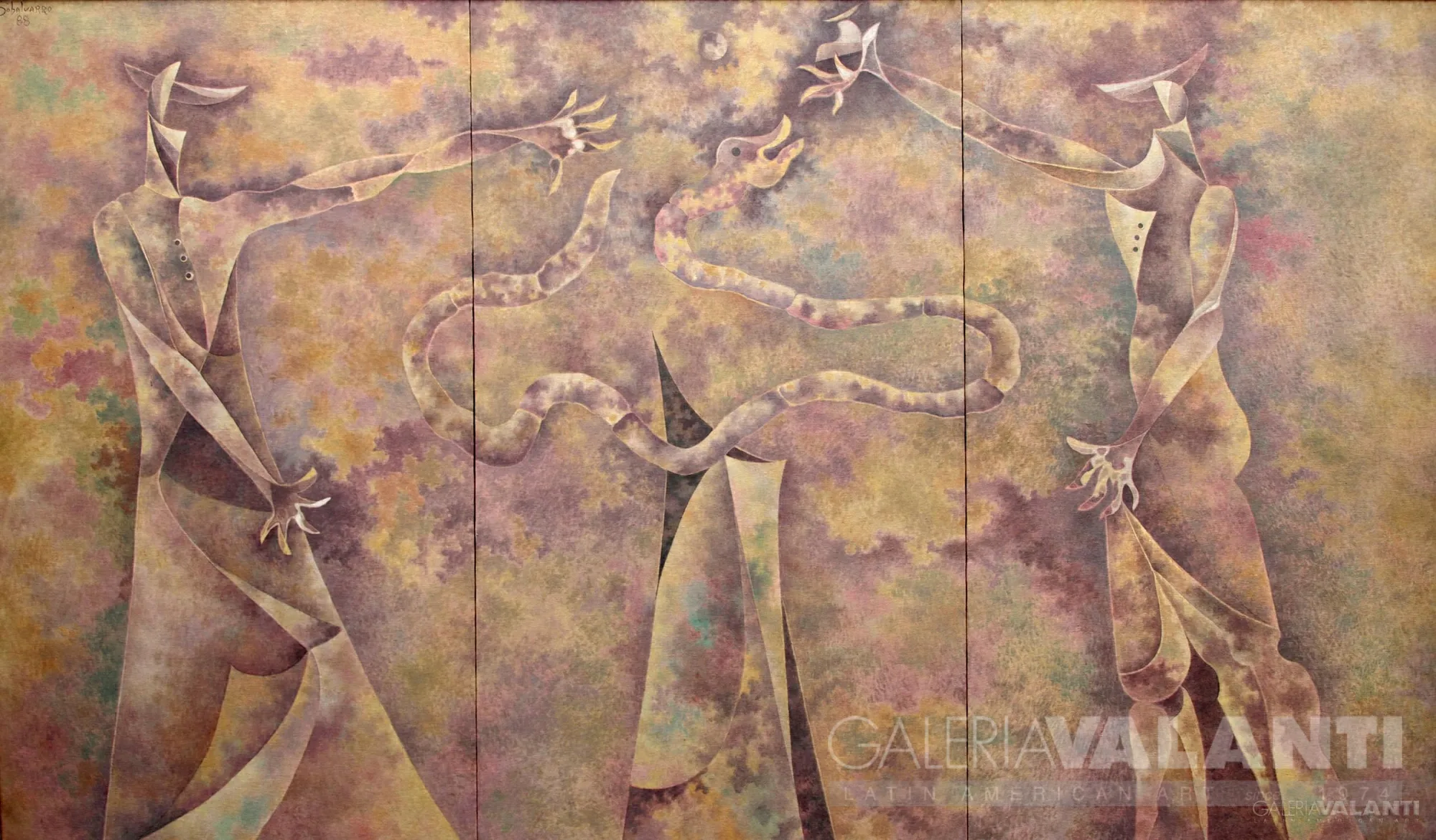
Adán y Eva en el Paraíso (tríptico)
- Year
- 1998
- Technique
- Oil/Canvas
- Dimensions
- 134 × 229 cm
- Status
- Available
- Palette
- ochre, mauve, sand, olive green, dark brown
- Brushwork
- Atmospheric scumbling and stippling of superimposed glazes with sharp linear edges.
Curatorial analysis
Curatorial analysis
A sandy, stippled haze pervades everything. Before the eye can decipher the figures, the surface asserts itself as a dense atmosphere of rubbed pigments and subtle glazes, where toasted ochres, dusty mauves, and faint moss greens coexist. Against this vaporous, almost geological backdrop, the three presences of the myth emerge with the precision of sheets carved from bone or polished metal: two stylized humanoid silhouettes flanking the composition and, suspended in the central panel, the sinuous undulation of the serpent.
The tripartite format does not isolate the figures, but rather articulates a continuous ceremonial frieze. Clean, luminous contour lines delineate the faceted planes of Adam and Eve, whose crescent-shaped heads and tapered limbs evoke archaic totems or figures from a sacred theater. On their torsos, small dark circles pierce the surface like buttons or anatomical anchor points. A magnetic tension sweeps across from left to right. Both figures extend their arms toward the center with tense hands, fingers splayed like fans, as if testing the air or pointing toward the creature levitating above a dark triangular plinth. The serpent, segmented and floating, breaks the vertical rigidity of the stretchers through a horizontal arabesque that guides the eye toward a small upper sphere, a distant suggestion of the forbidden fruit or a pale celestial body.
Light does not emanate from a discernible external source; it springs from the weave of the canvas itself and from the illuminated edges separating the faceted volumes from surrounding shadows. The Genesis narrative is stripped of any moralizing anecdote to become an esoteric rite, where pictorial matter feels fossilized by ancient eras. By transforming paradise into a chamber of mineral resonances and weightless bodies, the triptych suspends the fatality of the fall in an unresolved pause, transmuting the biblical myth into a mysterious moment of pure choreographic contemplation.
More works by Orlando Sobalvarro
1 work
Sold and historical
Similar works
By subject, palette and style
- Mujeres en el LagoXenia Gordienko · 1990
- Reposo AzulJorge Tamayo · 2000
- La cascadaLeonel González · 1990
- MadreFernando Carballo · 2004
- RecuerdosAndriy Halashyn · 2005
- Caballo NegroAlirio Palacios · 2005
- ParaísoInquire about availabilityCynthia Sáenz · 2016
- TRES MUJERESInquire about availabilityRafael Fernández
- CarnavalSoldSalvador Ávalos · 2013
- VeranoSoldJorge Rojas Alfaro · 2008
- Arbol de VidaSoldIleana Piszk · 2020
- El Artista y Su ModeloSoldBenjamín Cañas · 1982