The Bottle Rack
· Carlos Tapia
GALERÍA VALANTI / ART BLOG
The Bottle Rack
By Carlos Tapia | Visual Artist
Marcel Duchamp and the Extraordinary Transformation of an Everyday Object
In 1917, French artist Marcel Duchamp presented a porcelain urinal, repositioned it from its customary orientation, titled it Fountain, and signed it with the pseudonym “R. Mutt.” With this seemingly simple gesture, he took an ordinary, utilitarian object—a mere piece of everyday paraphernalia, or a chunche, as we might say in Costa Rica—and challenged the very notion of what could be considered a work of art.
It was almost an act of magic: “You are now a work of art.” And poof! The pumpkin turned into a crystal carriage. After centuries of painting, sculpture, drawing, and printmaking—from the imagery of prehistoric caves to the grand halls of academic art—Duchamp called into question one of the art world's most deeply entrenched assumptions.
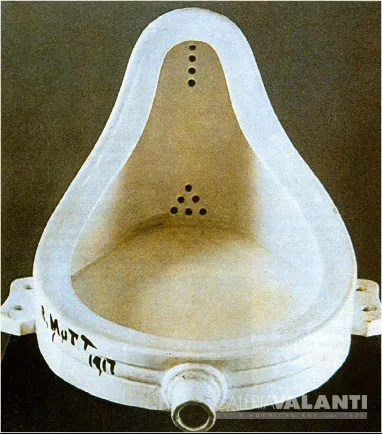
Marcel Duchamp, Fountain (1917). Reference image.
It is remarkable to consider that Fountain appeared just twenty years after the inauguration of Costa Rica's National Theatre in 1897. While one institution celebrated the traditions and splendor of the fine arts, Duchamp, from an entirely different stage, was questioning who had the authority to determine what constituted art.
This gesture is frequently associated with the subsequent development of Conceptual Art, an artistic practice in which the idea may take precedence over technical craftsmanship or the aesthetic qualities of the object. Yet it would be misleading to suggest that Duchamp single-handedly invented Conceptual Art overnight. Rather, he opened a decisive door, long before the movement became established in its own right.
But I am getting away from what I really want to tell you.
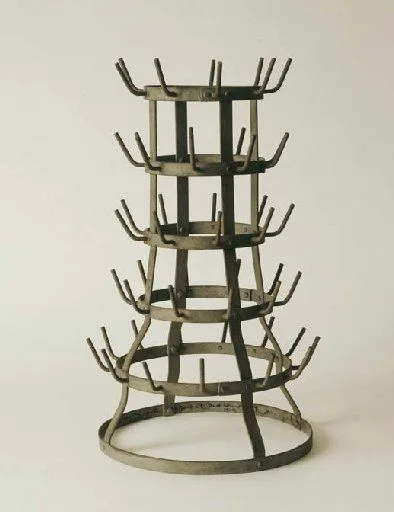
Three years before Fountain, in 1914, Duchamp had selected an even more prosaic object: a wine bottle-drying rack. He neither fabricated it nor transformed it into a conventional sculpture. He simply selected it and removed it from its original function. This humble domestic implement became one of the pioneering examples of what the artist would later call the readymade: a manufactured object whose selection and presentation fundamentally alter the way we perceive it.
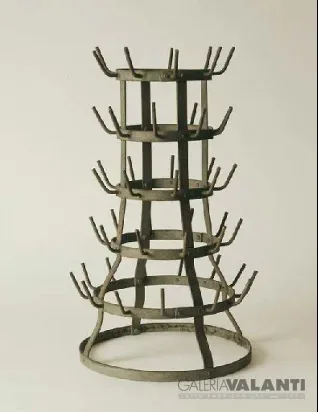
Marcel Duchamp, Bottle Rack (1914). Reference image.
And here we arrive at the irony that interests me most about this story.
During one of the artist's absences, his sister Suzanne disposed of the original bottle rack. The object vanished among the countless similar household implements that could be found throughout France. What the artist's vision had elevated to the status of a work of art was returned, through an ordinary domestic circumstance, to the anonymity from which it had emerged.
The paradox is magnificent: a bottle rack could become art simply because Duchamp declared it so, yet it could just as easily disappear like any other piece of household clutter—a mere chunche—the moment someone ceased to regard it as extraordinary. The versions of this work known today are later realizations; the original 1914 object has not survived.
Perhaps this is one of the most provocative questions Duchamp left us with: Does art reside in the object itself, in the artist's intention, in the institutional setting in which it is displayed, or in the gaze of the viewer?
Not all that glitters is gold. And not every object proclaimed extraordinary ceases, at its core, to be an ordinary object.
Image Credits
Fountain (1917) and Bottle Rack (1914): Reference images provided for this article.
Historical portrait of Marcel Duchamp (c. 1927): Library of Congress, George Grantham Bain Collection. Available via Wikimedia Commons: https://commons.wikimedia.org/wiki/File:Marcel_Duchamp_01.jpg

Reproduction rights and permissions should be verified prior to publication.
La traducción mantiene la voz crítica, irónica y personal de Carlos Tapia, pero utiliza terminología propia de la historia y la crítica del arte en inglés, como readymade, Conceptual Art, institutional setting y artist's intention.
También conservé la expresión costarricense chunche, acompañada de una explicación contextual, para mantener la personalidad del texto original. Esta versión está preparada para su publicación en el blog en inglés de Galería Valanti.
The views expressed in this post are the author's own and do not represent the position of Galería Valanti on political, religious or any other matters.