Jorge Araya
Santa Rosa de Santo Domingo
- Year
- 2026
- Technique
- Oil on Paper
- Dimensions
- 40 × 58 cm
- Status
- Available
- Palette
- cerulean blue, golden ochre, olive green, terracotta red, off-white, burnt brown
- Brushwork
- Precise and polished brushwork with a realist finish, featuring meticulous detailing in textures and cattle hide.
Curatorial analysis
Curatorial analysis
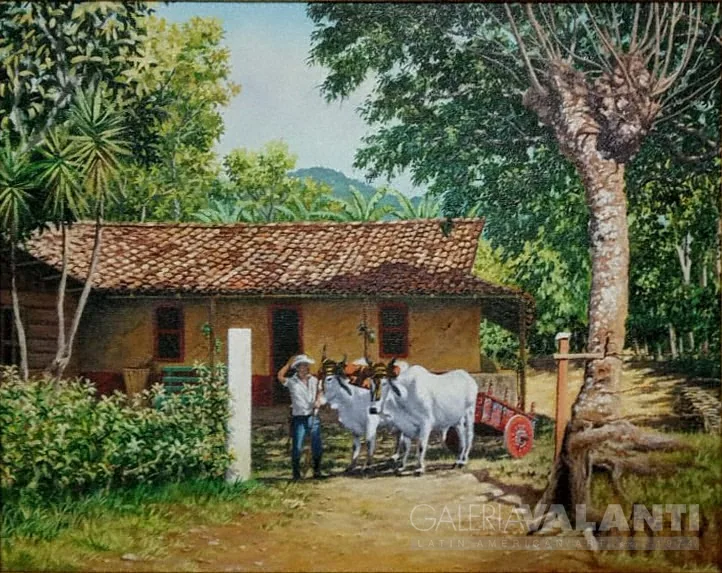
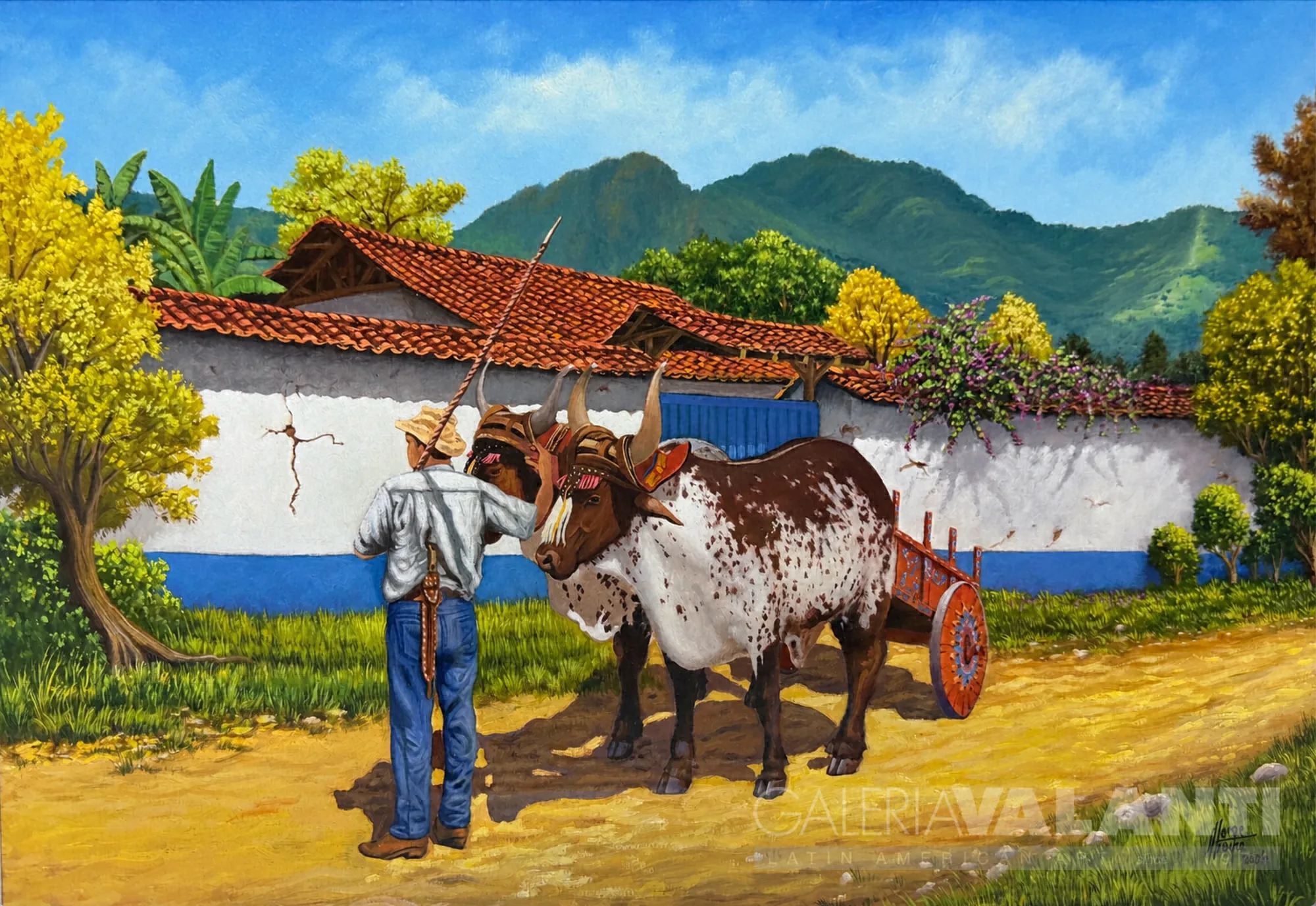
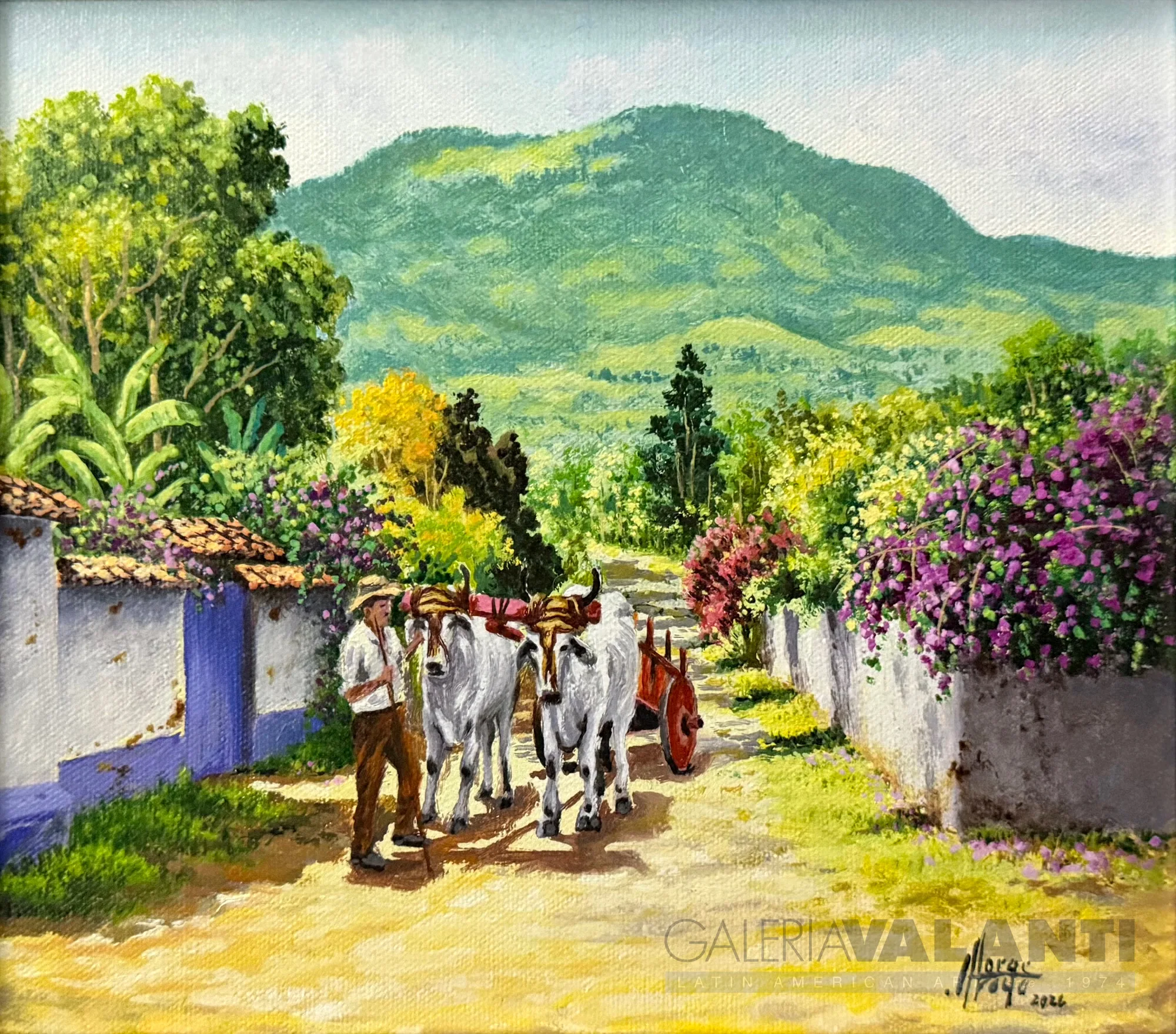
There is a complicit silence at the center of the scene, marked by the discreet gesture of the oxherd whose shadow-touched hand reaches for the ox's brow. Viewed from behind, with the goad cutting diagonally across the plane of the wall and the machete sheath at his waist, the figure eschews a frontal portrait to transfer prominence to his bond with the animals. The pair of spotted oxen, harnessed in carved wood and leather yokes, holds the viewer's gaze with a stately stillness that anchors the entire compositional weight in the left half of the canvas.
The spatial structure relies on a rigorous succession of horizontal bands. The dirt and stone path in the foreground, illuminated by direct sunlight casting sharp, dense shadows, guides the eye toward the traditional architecture. This whitewashed wall, accented by an indigo blue wainscot and capped with fired clay roof tiles, acts as a scenic screen separating the domestic sphere from the mountainous backdrop. Behind the roofs, exuberant vegetation and the bluish slopes of the central valley establish a transition toward a clear sky with a pristine atmosphere.
The chromatic treatment operates through deliberate complementary contrasts. The cobalt blue of the architectural details and clothing dialogues directly with the luminous yellows of the path and flowering trees, while the reddish patches of the cattle's coat find an echo in the modular rhythm of the roof tiles. The brushwork proves meticulous in resolving textures: the hairline cracks in the lime plaster, the roughness of the leather, the geometric filigree ornamenting the oxcart wheel, and the irregular speckling of the cattle hide.
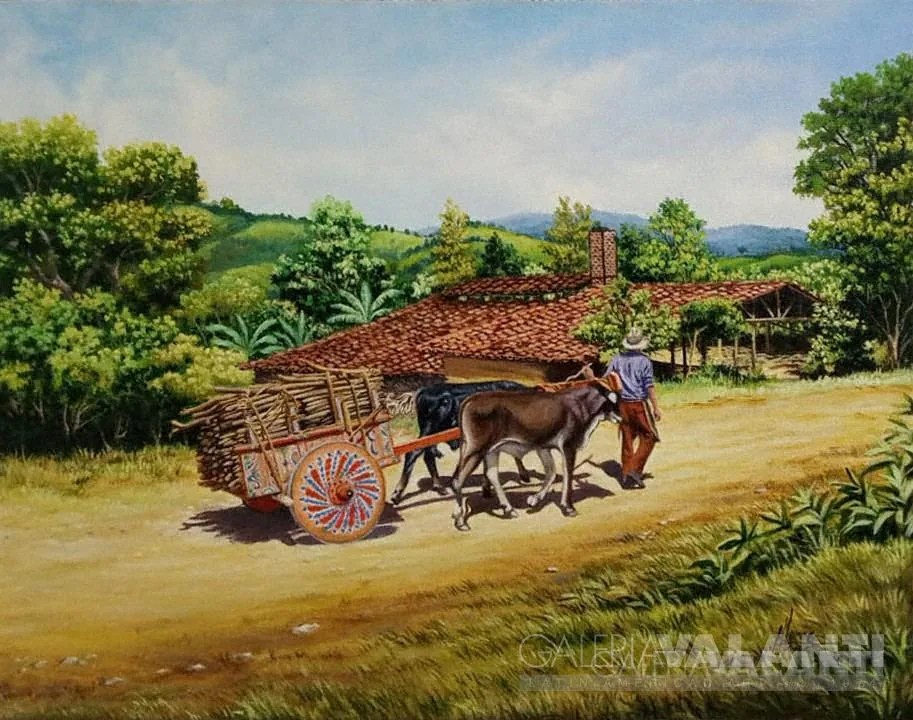
Rather than a mere folkloric record, the painting presents a pause in agrarian time. The oxcart neither advances nor retreats; it rests in a suspended moment where rural labor sheds its harshness to become a serene dialogue among human, animal, and their inherited landscape.
More works by Jorge Araya
15 works
Available works
- TrapicheJorge Araya · 2026
- Potrero en OrosiJorge Araya · 2018
- Con la carga de LeñaJorge Araya · 2012
- Escazú CentroJorge Araya · 2012
- San Antonio de EscazúJorge Araya · 2012
- Escazú Centro (Bco Nacional)Jorge Araya
Inquire about availability
- Casa San Antonio EscazúInquire about availabilityJorge Araya · 2022
- Yunta BueyesInquire about availabilityJorge Araya · 2022
- Casa TipicaInquire about availabilityJorge Araya · 2012
- Casa Típica de EscazúInquire about availabilityJorge Araya · 2012
- Escena Típica San Antonio de EscazúInquire about availabilityJorge Araya · 2012